Brains, Sabre Tooth Tigers and Flipping Your Lid
Our brains are amazing!
Here are just a few fabulous facts about our brilliant brains:
- The brain weighs about 1.4kg
- It is made up of 75% water, with the rest made up of protein and fats.
- Your brain produces electricity to power a pretty dim lightbulb!
- Even though it’s only about 2% of our body weight. The brain uses around 20-25% of the energy that we get from food and oxygen. It needs a lot of power to do everything it needs to keep us going.
- The brain has around 86 billion neurons (that’s 86,000,000,000!)
- Neurons are information signals. They take messages around the brain and nervous system.
- Neurons are really speedy – they transmit information to and from the brain at more than 240 kilometres per hour.


Brain Functions
Everything in our body is controlled by the brain...
- breathing
- heart beating and pumping blood around your body
- seeing
- moving
- hearing
- thinking
- yawning
- scratching your nose and...
...our feelings and emotions
sometimes our feelings can feel really big and overwhelming but when we understand how the brain works we can understand why we feel the big stuff (and the small stuff!) and calm those feelings.
The upstairs and downstairs brain model
To help explain strong feelings we are going to simplify the science and imagine the brain has two parts...
The upstairs brain (cortex) is the 'smart part' - thinking, planning, learning, decision-making, regulation and reflection.
The downstairs brain (limbic system and brain stem) are the 'emotional part' including our alarm system (including a part of the brain called the amygdala) which is meant to keep us safe from danger by getting us ready to fight or run away.
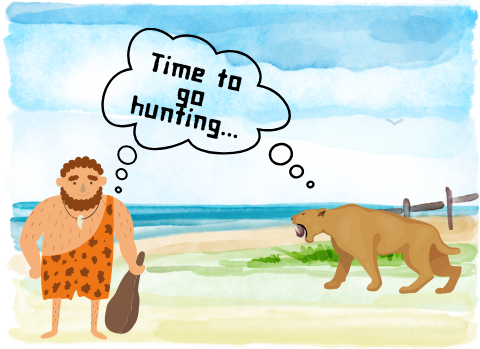
This part of the brain developed when we were cave people having to go out and hunt for food at a time when there were lots of dangers - like sabre tooth tigers around


Flipping our Lid
Most of the time the upstairs and downstairs parts work well together with our 'smart part' keeping a lid on emotional stuff. Sometimes when we experience strong emotions or the alarm system goes off... we can 'flip our lids'. The downstairs brain takes over. It's 'action stations', the thinking part of the brain goes offline as the body gets ready to try to keep us safe.
The Hand Model
A great way to remember what is happening when you flip your lid.
Hold up your hand. Tuck your thumb (representing the downstairs brain) into your palm. Now wrap your fingers (representing the upstairs brain) over your thumb. This is a model of a brain working in harmony. The upstairs and downstairs are connected and communicating.
When big emotions come along the downstairs brain takes over and you 'flip your lid' (fingers up) and the connection is broken.

Flipping your lid - 2 min video
'Name it to tame it'
Everyone flips their lids. The good news is we can learn to "name it to tame it" - by recognsing feelings and emotions and by understanding what's happening when we flip our lid and develop ways to help the 'upstairs brain' to get back in control. See the Wellbeing Toolkit for some ideas
Brilliant Brain Chemicals
Our brain produces some really cool chemicals that help our brain function well and control things in our body. Things like:
FEELINGS - some brain chemicals affect our feelings - they can make us feel happy, sad, excited, or calm...
SLEEP - there are brain chemicals that help you sleep or wake up...
FOCUS - brain chemicals can help us pay attention and learn
MOVEMENT - muscles get help to work well from some brain chemicals


Top up your feel good chemicals
There are four brain chemicals that are great for wellbeing. They are sometimes call the 'feel Good Chemicals' And the great news is there are loads of things we can do to boost them everyday!
They are:
- Dopamine (DOH-puh-meen)
- Oxytocin (OX-ee-TOH-sin)
- Serotonin (SEH-ruh-TOH-nin)
- Endorphins (en-DOR-fins)
Can you see what word the first letters of each happiness chemical spell out?
D.O.S.E.
It's all about getting your daily DOSE!!
Get moving, eat healthy foods, drink lots of water, play and do fun things, spend time outdoors and get plenty of sleep!
Check out the Ways to Wellbeing
Meet your Amazing Brain
An interactive exploration of our brain with fun facts, a peek at the parts and emotional enlightenment...
Knowing about the brain and how it works to keep us safe is our Superpower...
Click Barney below to start the adventure!
Trauma and the brain
Some people have had a tough time growing up or have had really stressful experiences in their lives (sometimes called 'trauma'). This means that their alarm system can get 'stuck' in the 'on' position and they can 'flip their lid' more quickly. It's not their 'fault' - their experiences have made them feel unsafe a lot of the time and so they are more alert and looking for danger a lot of the time. For people it is often really helpful if they practice 'naming it and taming it' with another person like a trusted adult. This is called co-regulation.
You can find about a lot more about trauma and the brain in some really good books for young people:
- 'The Strange and Curious Guide to Trauma' by Sally Donovan
- Help! I've got an Alarm Bell Going Off in my Head! by K.L.Aspen